Four-day intensive · Foundation 1 required
Tango - Foundation 2
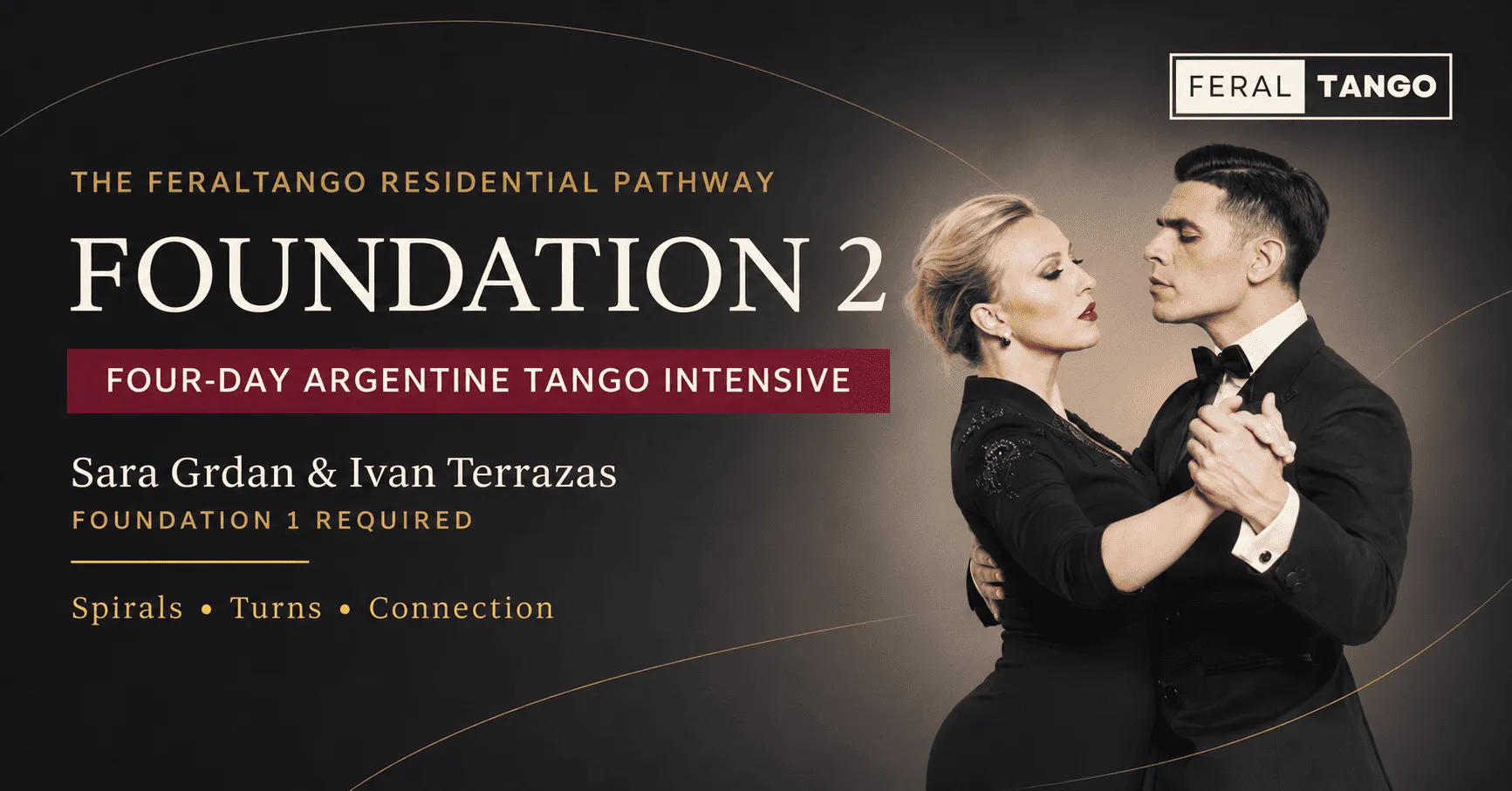
Foundation 2 revisits the organizing principles of Foundation 1 and extends them into spiral body mechanics, curved pathways and rotational systems. Across four days, participants learn to generate rotation through coordinated whole-body organization, adapt partner geometry as direction and radius change, and distinguish between turns organized around a common center and those organized around one dancer's axis.
DAY 1 Foundation 1 to Spiral Organization
The intensive begins by reconnecting the principles of Foundation 1 to the demands of curved and rotational movement. Axis, articulation, weight transfer, partner geometry and communication are reviewed, then reorganized to support coordinated spiral movement.
TECHNICAL FOCUS
• Axis, articulation and complete weight transfer
• Cross and parallel-system organization
• Partner spacing, alignment and directional pathways
• Spiral organization through the whole body
• Sequencing rotation without forcing the pivot
APPLIED INTEGRATION
• Preserving individual organization inside rotation
• Connecting spiral mechanics to partner communication
• Distinguishing functional tone from rotational tension
• Maintaining clarity as direction changes
DAY 2 Spiral Body Mechanics and Curved Movement
Day 2 develops coordinated spiral movement through the feet, legs, pelvis, spine and upper body. Curved movement is examined as a continuous relationship between internal mechanics, pathway and partner geometry.
TECHNICAL FOCUS
• Initiating spiral movement from the floor through the standing leg
• Spiral sequencing through the body
• Forward, backward and lateral movement on curved pathways
• Circular weight transfer and pivot mechanics
• Inside and outside positions relative to the curve
• Managing radius, direction and changing alignment
APPLIED INTEGRATION
• Producing rotation without disconnecting the body
• Preserving the embrace through curved movement
• Coordinating different pathways and travel distances
• Adapting tone, timing and energy to changing radius
DAY 3 Turns Around a Common Center
The couple now organizes around a shared center. Participants study how both dancers travel through related circular pathways while maintaining their own axes, a coherent embrace and continuous communication.
TECHNICAL FOCUS
• Establishing and locating a common center
• Leader and follower pathways around the center
• Forward, side and backward rotational steps
• Giro - or turn - structure and circular sequencing
• Radius, spacing and relative position
• Energy generation and redirection in continuous turns
• Entering, sustaining and exiting rotation
APPLIED INTEGRATION
• Maintaining two clear axes within one rotational system
• Synchronizing unequal pathways and travel distances
• Changing direction without losing the shared center
• Building adaptable turns rather than fixed sequences
DAY 4 Turns Around a Single Axis
The final day examines rotational systems organized around one dancer's axis. Participants learn how the moving partner travels around a stable center while both dancers manage spiral mechanics, energy, geometry and connection.
TECHNICAL FOCUS
• Establishing one dancer's axis as the rotational center
• Organizing the moving partner's circular pathway
• Spiral mechanics for the central and traveling partners
• Managing distance, radius and rotational energy
• Maintaining axis during changing partner position
• Transitions as the rotational center changes
• Controlled entry, continuation and exit
APPLIED INTEGRATION
• Connecting single-axis turns to common-center turns
• Maintaining communication through asymmetrical movement
• Modulating energy without pulling or collapsing
• Applying WHAT, HOW and WHY to rotational choices
• Developing personal expression without losing structure
Curriculum progression
SPIRAL ORGANIZATION > COMMON CENTER > SINGLE AXIS
Foundation 2 develops the mechanics and spatial understanding required for adaptable rotational movement. Participants progress from coordinated spiral organization to turns in which both dancers move around a common center, and then to turns organized around one dancer's axis. Throughout the intensive, the objective remains the same: to preserve clarity, stability and communication as direction, radius and partner relationship change.